How RFID Bike Tracking Works
An RFID shipping label contains a tiny chip and antenna. When the label passes a reader in the carrier’s facility (or elsewhere for that matter), the reader’s radio signal powers the chip, which sends back the package’s tracking number. That ID, plus the reader’s location and a timestamp, becomes a tracking update.
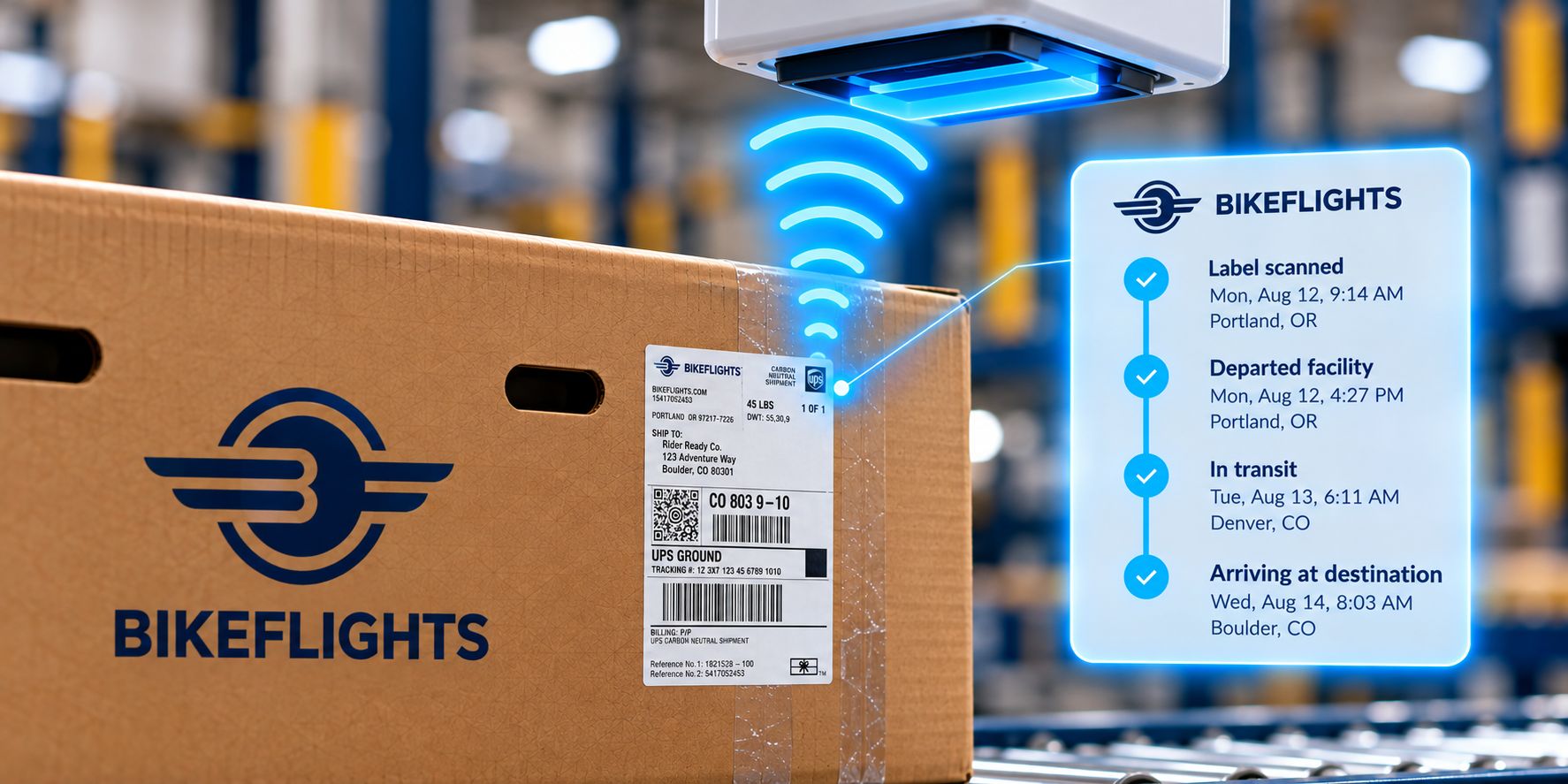
- Printed label looks like an ordinary shipping label
- Chip + antenna antenna roughly one inch long
- Backing no battery, no power source
How an RFID Label Is Created
A special RFID printer is used to create an RFID label. As the label is printed, the printer encodes the shipment’s tracking number on the label’s RFID chip.
What is Inside an RFID Label
An RFID label looks like an ordinary shipping label. Sandwiched inside is a microchip and a small antenna roughly one inch long. The chip has just one, very important thing: a unique tracking number. The chip itself actually holds no location data, no customer information and no shipment history. It’s simply an identifier, nothing more. Everything else is added by the system that reads it.
Why It Needs No Battery
Passive RFID labels are a bit of a technological marvel as they have no onboard power source. The reader emits a radio field, and the label’s antenna harvests just enough energy from that field to wake the chip and transmit its ID back. The chip is dormant the rest of the time. This is why an RFID label costs cents rather than dollars, weighs nothing, never needs charging and cannot run out of power mid-shipment.
How a scan of an RFID label happens
- A parcel with an RFID label approaches a reader which is mounted at a dock door, a sorting point, or on a handheld unit.
- The reader emits a radio field that energizes the chip in the label.
- The chip transmits its unique tracking number back to the reader.
- The system pairs that tracking number with the reader’s known location and the current time.
- That location and timestamp are written to the shipment’s tracking record.
- The package is checked at the points where a reader catches it, but not continually.
The whole process takes milliseconds and, most often, requires no human action. The parcel does not need to be visible, aimed, or isolated. Several labels in the same area can be read at once.
How a read becomes a tracking update
Each read feeds the carrier’s operational record for that shipment, which in turn feeds the shipment’s tracking page the rider sees. The consumer is usually seeing the same scans or events that the carrier and the shipper are seeing.
That shared view matters when something goes wrong. If a shipment stalls, everyone can see where it last was scanned, which turns what used to be a guessing game into a specific question about the package sitting in a specific facility.
RFID’s biggest limitation
RFID updates are event-based, not continuous. A scan of a package only happens where a reader is positioned (like in a sorting facility). Between two scans, the shipment’s exact position is only generally known. It’s exactly the same as with barcodes in that way. What RFID improves is the density and reliability of those events, especially for oversized parcels that automated scanning tends to miss.