RFID vs. Barcode vs. GPS Tracking
Barcodes need to be seen and aimed at in order to be scanned. RFID is read wirelessly, at a distance, without line of sight needed. GPS reports continuous location but needs a battery and is visible only to whoever owns the GPS tracking device. When it comes to bike shipments, each kind of tracking has positives and negatives.
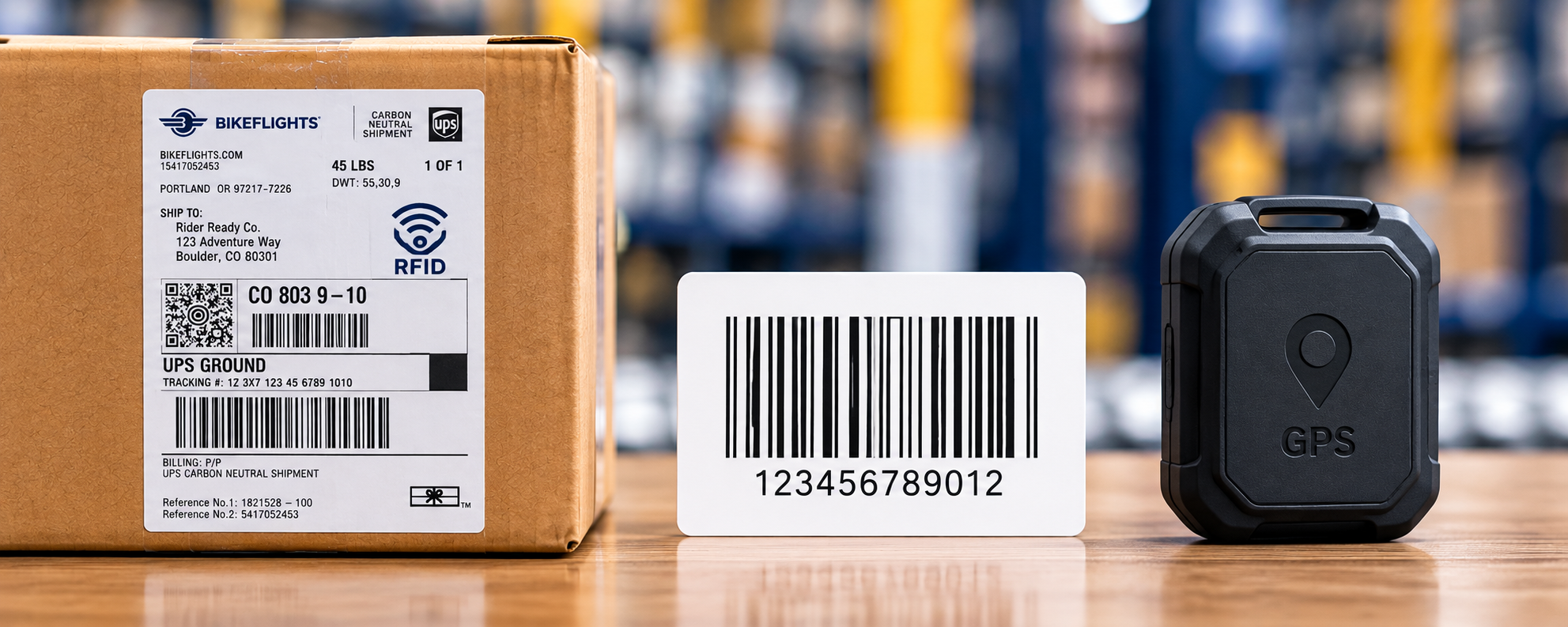
Side by side
| RFID | Barcode | GPS | |
|---|---|---|---|
| Needs line of sight | No | Yes | No |
| Power source | None (passive) | None | Battery required |
| Read range | Feet, wirelessly | Inches, aimed | Continuous via satellite |
| Works on oversized boxes | Yes | Often no | Yes |
| Who sees the data | Rider, shipper, carrier | Rider, shipper, carrier | Device owner only |
| Tied to carrier operations | Yes | Yes | No |
| Location between reads | Not shown | Not shown | Shown |
| Hardware to buy or return | None | None | Device purchase required |
Barcode tracking
A barcode is a printed pattern read optically. It is basically free to produce, universally supported and has been the benchmark for global logistics for decades. Barcodes work well and their biggest constraint is physical: a scanner has to “see” the barcode. The label must be facing outward, be undamaged and be presented clearly to the reader. On a conveyor with uniform boxes, that happens near automatically but with an oversized bike box (which is often moved by hand and not on a standard sorting belt), it happens when someone is able to or remembers to scan it.
RFID tracking
RFID removes the issue of needing to aim a scanning beam at a label. The label is read by radio, through cardboard, from several feet away, at any orientation, and in bulk. Many times, these are scans that a barcode-based system would miss, but are captured automatically.
The honest trade-off: RFID still only reports at specific scanning points (most often at a sorting facility). It does not tell you where a parcel is between facilities, and it depends on the carrier having a high density of readers installed in its network. Without that infrastructure, an RFID label is just a label.
GPS tracking
A GPS tracker is a battery-powered device placed inside a parcel that is being shipped. It reports its own position continuously and independently of the carrier. It is genuinely useful information a scan-based system cannot provide.
The costs of GPS tracking are much greater than a barcode or even RFID label. The GPS device must be bought, charged before shipping and retrieved afterward. Oftentimes, GPS batteries die. Satellite signal is notoriously poor inside metal trailers and large warehouses. Most importantly, only the device owner sees the tracking data. So, if a consumer has placed a GPS tracker inside a parcel, they can see it, but the carrier cannot. So a rider watching their bike stuck in a sorting facility via their GPS tracker or Apple AirTag (which is not technically a GPS device) has to contact the shipping company to let them know where the bike box or parcel is located and hopefully persuade the shipping company to find it and get it back on track!
So which is right for a bike?
The practical answer is whichever system the carrier uses. If it’s RFID, great. Most importantly, when the rider, the shipping service and the carrier are all reading the same record, a problem can be solved rather than just observed.
GPS remains a useful tool for a shipment where independent, continuous position genuinely matters and the consumer is willing to buy, charge and recover a device as well as be responsible for resolving any issues with the carrier. For a bike moving through a carrier network, RFID delivers most of the benefit with none of the maintenance, extra cost or frustration.